9.3 Million American Jobs at Risk from AI. The Safe Zone Is the Poverty Zone.
Tufts University's first AI Jobs Risk Index maps every US metro and occupation. Historians face 67% displacement. Roofers face 0%. The pattern is brutal.
 Vlad Makarovreviewed and published
$757 billion. That's the annual wage income at risk from AI displacement in the United States, according to a new index from Tufts University — roughly the entire economy of Belgium. And the jobs most likely to survive? They're the ones that already pay the least.
The Index
The American AI Jobs Risk Index, released March 24 by Digital Planet at Tufts' Fletcher School, is the first study to map AI job vulnerability across 784 occupations, 530 metro areas, and all 50 states simultaneously. It draws on 15 years of labor market data and projects that 9.3 million jobs face displacement risk in the next 2-5 years, with the range spanning from 2.7 million under slow adoption to 19.5 million if agentic AI takes off faster than expected.
The title of the report says it plainly: "Will Wired Belts Become the New Rust Belts?"
Who Gets Hit
The most at-risk occupations aren't the ones most people would guess. Historians top the list at 67% displacement risk. Writers and authors face 57%. Computer programmers — the people building AI — face 55%. Web designers hit the same number. The irony is sharp: over one million workers whose jobs involve studying, building, or reporting on AI face displacement rates between 26% and 55%.
The most exposed by raw AI capability scores paint a similar picture: web developers (98.3/100), database architects (98/100), data scientists (96.9/100). These are skilled, well-paid roles — not the factory jobs that defined previous waves of automation.
Half of all projected job losses concentrate in just 26 occupations. Eight occupations drive 25% of total displacement. Software developers, management analysts, and marketing specialists face the largest absolute income losses because they combine high salaries with large worker populations.
Who's Safe — and Why That's Uncomfortable
Thirty-eight percent of American workers face less than 1% displacement risk. Roofers. Orderlies. Dishwashers. Excavating machine operators. The pattern is stark: the jobs AI can't do are the ones that involve physical work in variable conditions. The report's authors put it directly: "The safe zone is the near-poverty zone."
This inverts the usual automation narrative. Previous waves of technology disrupted blue-collar manufacturing and routine clerical work. AI is going after the cognitive, analytical, creative work that was supposed to be automation-proof — the work that college degrees and professional credentials were meant to protect.
The Geography
Silicon Valley leads all metros at 9.9% of jobs at risk. New York, LA, Washington DC, San Francisco, Chicago, Dallas, and Boston each face at least $20 billion in projected annual income losses. The top five metros together lose more than Hungary produces in a year.
The surprise isn't the big tech hubs — it's the university towns. Durham-Chapel Hill, Boulder, Ann Arbor, Ithaca, and Madison all rank in the top 25 most vulnerable metros. These are the "Wired Belts" of the report's title — regions whose economies are built on exactly the kind of knowledge work that AI targets. Washington D.C. has the highest state-level vulnerability at 11.3% and zero AI legislation.
The Augmentation Trap
Perhaps the most unsettling finding: augmentation leads to displacement, not away from it. For every 1 percentage point increase in job automation potential, there's a projected 0.75 percentage point job loss. "The more AI enhances worker efficiency," the report states, "the more expendable individual workers become."
This cuts against the industry's preferred narrative — that AI will augment workers rather than replace them. The data suggests augmentation is the first step on the displacement pipeline, not an alternative to it. Thirty-three "tipping point" occupations spanning 4.9 million workers could swing from under 10% to over 40% displacement depending on how fast companies adopt AI tools like Claude Code and its competitors.
The Political Collision
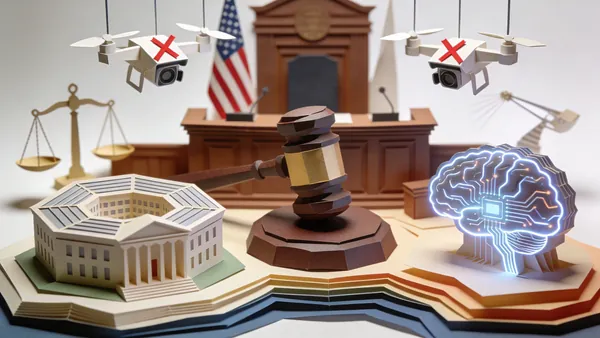
The states most at risk from AI job displacement are passing four times more AI legislation than the safest states. In December 2025, the White House directed the Justice Department to challenge state-level AI laws and threatened to withhold broadband funding from states that legislate on AI. The report's lead author, Bhaskar Chakravorti, frames this as the central political tension: "The states and metros most at risk are already the most active in seeking AI regulation — and the federal government is telling them to stand down."
The research doesn't estimate job creation from AI — the authors acknowledge this as a limitation they plan to address in future updates. But even without that counterbalance, $757 billion in annual wages at risk is a number that no policy framework in the US is currently designed to handle.