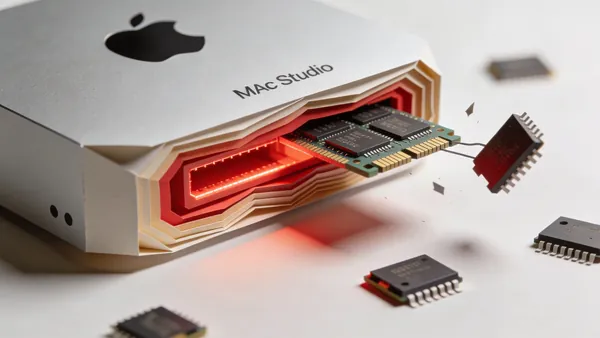
Apple's M5 Ultra Mac Studio Brings 1.2TB/s Memory Bandwidth to Local LLMs
Apple's M5 Ultra Mac Studio pushes unified memory to 512GB with 1.2TB/s bandwidth. We break down what that means for local LLMs — and what the hype gets wrong.
 Vlad Makarovreviewed and published
On August 25, Apple announced a new Mac Studio powered by the M5 Max and M5 Ultra — and one specification is doing the heavy lifting in the AI community: the M5 Ultra's 1.2TB/s of unified memory bandwidth, 50 percent higher than the M3 Ultra's 819GB/s. For anyone running large language models on a desktop, bandwidth is the number that decides how fast a 100B-plus parameter model actually generates tokens, and 1.2TB/s is the highest Apple has ever shipped in a Mac.
What Happened
The new Mac Studio is a chip refresh wrapped in the same compact chassis the line has used since 2022. The M5 Max version keeps the previous $2,499 starting price — now with 36GB of unified memory and a 512GB SSD — while the M5 Ultra starts at $5,499 with 96GB and 1TB of storage. Pre-orders opened the same day, with shipping scheduled for September 22 alongside macOS 27 Golden Gate.
The M5 Ultra itself is the headline. It fuses two M5 Max dies into a quad-die package connected by a next-generation UltraFusion interconnect rated at 4.4TB/s, yielding up to a 36-core CPU, an 80-core GPU, and a 32-core Neural Engine. For the first time on an Ultra chip, the GPU cores include the Neural Accelerators Apple introduced with M5 — per-core matrix-math units credited for a claimed 4.3x peak AI compute over the M3 Ultra and 9.8x over the M1 Ultra.
The specs that matter for AI:
- M5 Max: 18-core CPU, up to 40-core GPU with Neural Accelerators, up to 128GB unified memory, 614GB/s bandwidth
- M5 Ultra: 36-core CPU, 80-core GPU, 32-core Neural Engine, up to 512GB unified memory, 1.2TB/s bandwidth
- Clustering: up to four Mac Studios can pool memory over Thunderbolt 5 + RDMA, with Apple claiming 3x faster inference than a single unit
- Storage: PCIe Gen 6 NVMe, up to 2x faster (15GB/s); Wi-Fi 7, Bluetooth 6, Thunderbolt 5 connectivity
- Availability: the 512GB M5 Ultra configuration arrives only in late October, price still TBD
Why the Local LLM Crowd Cares
The Mac Studio remains Apple's only desktop capable of holding a genuinely large open-weight model. A model like Llama-4-180B in 4-bit quantization needs roughly 90-100GB of RAM for weights alone; the 512GB M5 Ultra can hold several of them at once, and the 1.2TB/s figure determines how quickly the chip can stream those weights through its GPU cores. In practical terms, it is the difference between a model that feels interactive and one that crawls.
On Reddit's r/LocalLLaMA, the announcement was treated as a local-inference milestone, with early community reports of roughly 2x speedups over M4-generation hardware on 180B-class models. Apple's own LM Studio figures point the same direction — up to 9.8x faster prompt processing than the M1 Ultra and 4x over the M3 Ultra — though those are Apple's benchmarks, measured against hardware that is now several generations old.
There is also history here. In March, Apple quietly removed the 512GB option from the M3 Ultra Mac Studio as the global DRAM shortage tightened, and the local-LLM community lost its most capable machine. Now the configuration is back — but not until late October, and without an announced price. The June price hikes that pushed the outgoing Mac Studio up $500 are a reminder that Apple is not immune to memory economics.
What the Fine Print Says
The 1.2TB/s number is real, and it is the largest bandwidth jump the Mac line has seen in a generation. But it deserves context the marketing materials skip.
First, unified memory is not dedicated GPU memory. The same 512GB pool serves the CPU, GPU, Neural Engine, and macOS itself; a 512GB machine gives a model something less than 512GB, and every background process competes for the same bandwidth. Second, 512GB was already possible on the M3 Ultra — the M5 Ultra's real advance is bandwidth, not capacity. Third, bandwidth alone does not remove the quantization question: a model that exceeds memory still will not fit, and one that fits still needs software — MLX, llama.cpp, the new Core AI framework — to actually exploit the pipe. And on paper, 1.2TB/s remains far below the multi-TB/s HBM stacks on data-center GPUs, so claims of replacing a GPU server with one desktop should be taken with the usual skepticism.
What's Next
Independent benchmarks will settle how much of the 4.3x claim survives contact with real workloads, and the MLX ecosystem will determine whether the bandwidth shows up as tokens per second. Expect the 512GB price to be announced only when Apple is ready to absorb the DRAM costs — and expect it to hurt. For now, the M5 Ultra Mac Studio is the strongest argument yet that a serious local inference rig can live on a desk; whether it is a good deal depends entirely on what Apple charges for that last 256GB.