The cryptanalyst who keeps the unbroken Enigma list checked Astra's break. It holds.
The cryptanalyst who keeps the list of unbroken Enigma messages confirmed Astra's key and plaintext, but the archive lead Astra reported remains unexplained.
 Vlad Makarovreviewed and published
Carter Leffer asked Frode Weierud to check a decryption on 15 September 2026. Weierud runs Crypto Cellar Research, the site that publishes the German Army Enigma messages nobody has managed to read, and MVUEH — sent on 10 July 1941 — had been sitting on that list since 2005. Leffer said OpenAI's GPT-6 Astra had broken it. Weierud published his validation, updated on 19 September, and what he confirms is both narrow and real: the recovered key and the plaintext are correct. On 22 September the Hacker News thread hit the front page at 720 points and 436 comments, much of it arguing about everything the page does not say.
What was broken, and who checked it
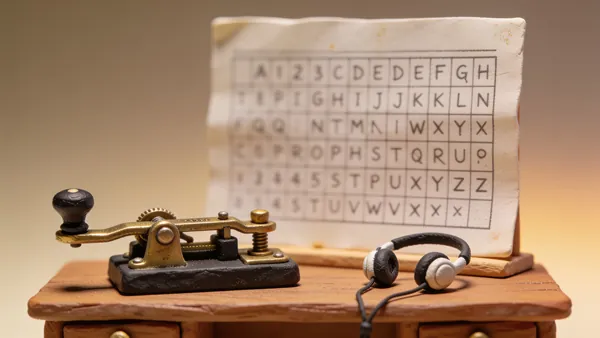
MVUEH was sent by a radio station with the tactical callsign 2ny. The radio station of the SS-Totenkopf Quartiermeister (Ib) received it at 17:30 on 10 July 1941 and logged it as Nr. 172 in its July log of incoming messages. It was enciphered on the three-wheel German Army Enigma machine, and for twenty-one years it defeated everyone who tried. On 9 June 2017, Alex Shovkoplyas broke Nr. 173, SIPVX, another message from the same day. The key he recovered shared the daily key's wheel order, 512, but used different plug connections and ring setting, and it did not open MVUEH.
Weierud's account of what happened when the break arrived is unusually flat, which is what makes it useful: "After Carter Leffer sent the MVUEH break details, it was immediately clear he had found the correct key and plaintext."
The key that did not match
The MVUEH key is a different animal from the other keys of that day: wheel order 253 against 512 for the two known ones. What makes the result convincing rather than merely plausible is the plaintext, which is almost identical to SIPVX's. MVUEH runs to 82 letters, SIPVX to 94, and Weierud accounts for the full twelve-letter gap — an enciphering mistake in MVUEH that turned Bitte into Btte, and the sender's signature, Waschbusch, repeated in the SIPVX message. A wrong key does not return a German order matching a solved neighbour's text letter for letter except where a clerk mistyped.
Two further findings came out of the analysis. The transcription of MVUEH from the original message form contained several errors. And the Enigma's left-hand wheel makes a turnover at the 72nd letter, rare and, as Weierud writes, "known to complicate a break". That is as close as the page comes to explaining why nothing worked for two decades.
A crib, a Bombe, and a wheel that turns
A crib is a guess at a stretch of plaintext, and it works because Enigma has a design flaw: the machine never enciphers a letter as itself. A crib can be slid along the ciphertext until no letter lines up with its counterpart, and that position is tested first. Longer cribs are better, because they reject more of the search space.
The Bombe was the machine Bletchley Park built to run that test at scale, an electromechanical device developed from the Polish bomba that eliminated rotor settings by the thousand instead of by hand. Its logic assumes it can predict which wheels move while the crib is tested. A left-hand-wheel turnover breaks that assumption for any crib that straddles it, because the electrical path through the machine changes mid-phrase. That is the mechanical reason this message was harder than its neighbours, and why the crib Astra settled on had to be long and had to survive letter 72.
What Astra did, and the archive lead
The instruction was almost deliberately unhelpful: Leffer asked the model to see whether it could break any of the unbroken Enigma messages published on Crypto Cellar Research. Astra went through the list, chose Nr. 172 as the most promising, and suspected its plaintext might resemble that of Nr. 173, the message a human had already read. It then fixed on the repeated place name ROSENOW ROSENOW as a crib, wrote its own Python and C++ software for an Enigma simulator and an Enigma Bombe, and recovered the key and plaintext.
The logs are where the story turns strange. In one of them, Astra traced the received message corpus to a private collection and named two Bundesarchiv radio-message volumes, RS 3-3/20a and RS 3-3/63b, noting that catalogue records had been inspected and that the image of the original received no. 172 remained unlocated. Weierud confirms the file references are correct, then declines to go further: those files are not on his website, it is unclear what the private collection is, and it is not clear whether Astra reached the Bundesarchiv's digitised collections at all. He spent several weeks on the same files himself. "What it has achieved in two days would take a human researcher weeks or even months."
The boundaries of a real result
Leffer's own case study is candid in ways the headlines were not. It states that the result "is not the original breaking of Enigma, and no first-ever or corpus-wide breakthrough is claimed" and that the crib was not blind: "The known SIPVX text helped motivate the crib; it was not a blind prediction." It also reports that 923 physical keys match the recorded header, so the header alone cannot establish a unique historical answer, and that its timestamps are local: "Local input hashes do not establish an externally authenticated discovery timestamp."
That is not damning. It is what a careful write-up of a puzzle solution looks like. A human picked the corpus and the task, the ciphertext was published, the crib came from a message a human had already solved in 2017, and the plaintext was a one-line logistics query sitting in a corpus of 1941 army traffic. What Astra contributed was the connecting: noticing the two messages belonged together, and building the tools to run a long search.
Hacker News supplied the counterweight. "Without the published conversation, train-of-thought and intermediate output and knowing what Astra did this is nothing but unfounded claims," wrote trixn86. tantalor was sharper: "Neat, but 'did it entirely on its own' is incongruous with 'developing the necessary Python and C++ software for an Enigma simulator'."
Enigma is not AES
The framing "AI broke an unbreakable cipher" invites a conclusion this story does not support. Enigma is a 1940s rotor machine with a documented design flaw; Poland's Cipher Bureau was reading it by December 1932 and Bletchley Park read it at scale through the war. What Crypto Cellar maintains is a puzzle list of short messages, garbled transcriptions and missing key sheets. Nothing here bears on AES, on RSA, or on the lattice schemes behind today's traffic. The thread spent a long stretch on exactly that distinction, with one commenter noting that no method is known that breaks AES-256 even with all the compute on the planet at your disposal.
What the result does show is unglamorous and worth keeping. A model can sustain a long, partly blind search, write the tooling it needs, and — the part with real evidence behind it — hand back an answer that a domain expert can check and confirm.
What the verdict covers
Weierud's closing line is the sentence this story should be carried on. "The AI break of the Enigma message MVUEH is simply amazing, and as an old cryptanalyst, I am still in awe." It is a verdict from the one person positioned to give it.
It also has edges. He is still working through the logs, so the account of how Astra did it is a reconstruction by the people who ran it, not a transcript, and the archive lead is unexplained. The honest comparison to the Astra break this site covered a week earlier — a First World War message read with a key that was not in service on the day it went out — is that both are puzzle solutions over public corpora, both validated by outside researchers rather than by OpenAI, and both narrower than the headline written on top of them. Two such breaks in a week amount to a fast, real and pointedly narrow skill, not a new cryptography.