Kimi K3.1 Pro's weights are 1.56 TB and nobody has scored the download
Moonshot published the full Kimi K3.1 Pro weights: 96 shards, 1.56 TB, a licence ending at $20M of API revenue, and no independent eval of the files yet.
 Vlad Makarovreviewed and published
Moonshot AI made good on the promise in its own launch post: the full weights of Kimi K3.1 Pro are on Hugging Face, and the r/LocalLLaMA thread that found them drew 1,361 points and 248 comments on 4 November. The line that travelled was that a frontier-class model had become a download. That part is true. The rest of the story is in the file listing: 96 safetensors shards, 1.56 terabytes, a licence that stops being free once you sell enough API access, and no independent score for the checkpoint anyone can now fetch.
The blog promised it by 4 November
Moonshot announced the model on 23 October with a line that reads oddly in hindsight: "The full model weights will be released by Nov 4." The repository was created on 2 November at 04:13 UTC, and the Reddit post that made it news landed on 4 November at 15:44 UTC.
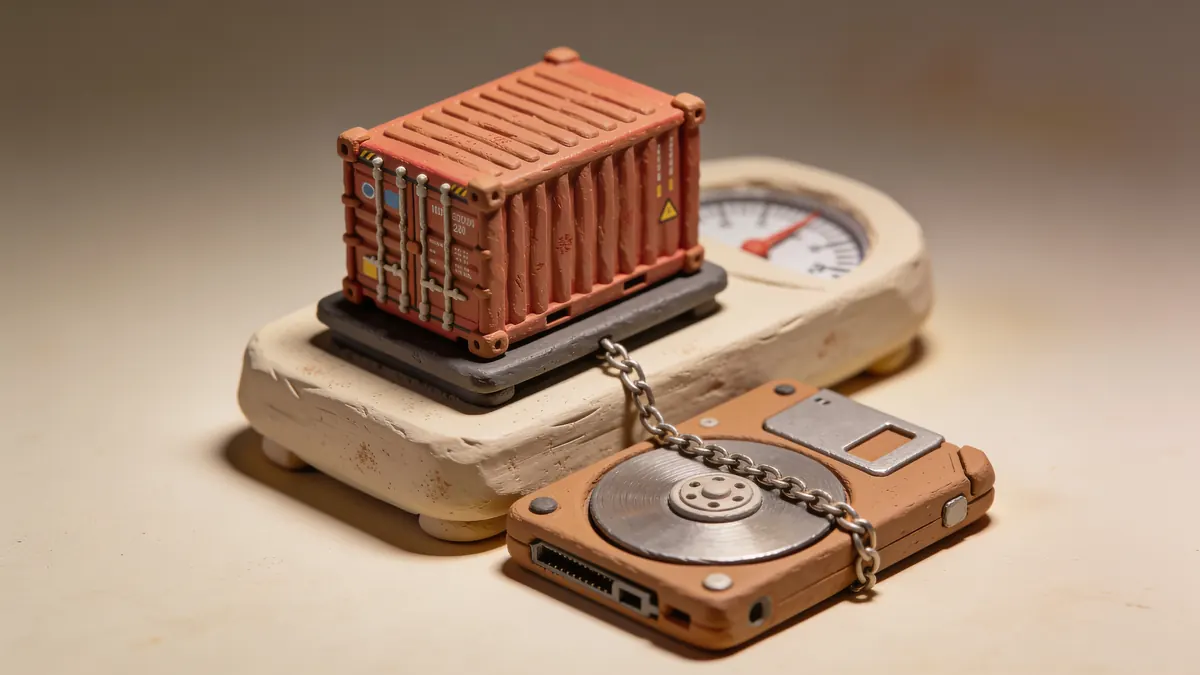
What shipped is one tree, not a family. No bf16 sibling and no FP8 build exists in the organisation's model list. The only Kimi K3.1 Pro Moonshot published is already quantized: MXFP4 weights, MXFP8 activations, quantization-aware training. That is why the download is 1.56 TB rather than the 5.56 TB a bf16 copy of 2.78 trillion parameters would occupy.
The parameter count is the first place the marketing and the metadata part. Moonshot's announcement calls it "our most capable 3T-class open-weight model". The card's summary table says 2.8T total with 104B activated, and Hugging Face's safetensors metadata counts 2,780,110,363,392. Three trillion sits about 8 per cent above the number in the repo.
Where 1.56 terabytes actually lands
The tree endpoint returns 112 files totalling 1,561,355,966,953 bytes, of which 1,561,293,160,568 sit in 96 shards.
| Measure | Value |
|---|---|
| Weight files | 1,561,293,160,568 bytes (1.56 TB, 1.42 TiB) |
| Shards | 96, mean 16.3 GB, largest 17.0 GB |
| Parameters, Hub metadata | 2,780,110,363,392 |
| Effective precision | 4.5 bits per parameter |
| bf16 copy, for comparison | 5.56 TB |
Divide and the precision falls out: 1.561 TB over 2.78 trillion parameters is 4.5 bits each. That is MXFP4 with an 8-bit block scale every 32 values, plus 57.4 billion parameters the index still counts in BF16.
Then divide for hardware. Twenty 80 GB accelerators hold 1.6 TB, which covers the weights and little else; it takes forty-nine 32 GB cards to clear the same bar. IntelArtiGen noticed the arithmetic: "I'm surprised the repo is 'only' 2TB. Ah right it's already mxfp4/mxfp8." The most candid reply comes from magicomiralles, who has 256 GB of VRAM and wrote that "I'm closer to your setup than the necessary ram to run this model. We are the 99%."
The licence ends at $20 million of API revenue
Hugging Face files the repo under license:other with license_name: kimi-k3.1-pro, which is accurate: the LICENSE file is 3,077 bytes of custom text, not MIT, Apache or anything an OSI list will carry.
It opens generously. "Permission is hereby granted, free of charge, to any person ... to deal in the Software without restriction," provided the copyright notice travels with copies. Run it, fine-tune it, sell derivative works.
Then section 2. "Model as a Service" means giving a third party access to inference or fine-tuning in a way that allows meaningful control over inputs, parameters or training data; products with model capabilities embedded in features are excluded, as is "mere relaying of requests to models hosted by others". If you or an affiliate run that business and the aggregate revenue of you and your affiliates exceeds $20 million "in total over any consecutive 12 months", you must sign a separate agreement with Moonshot "before using the Software or its derivative works for any commercial purpose".
Section 3 has nothing to do with APIs. Any commercial product past 100 million monthly active users, or $20 million in monthly revenue, must display "Kimi K3.1-Pro" prominently in its interface. Section 4 exempts internal use and anyone going through Moonshot's own products or certified partners.
The Reddit shorthand, free for personal use with attribution and a separate deal only for API providers, loses two things. The $20 million is measured on the whole corporate group rather than the model, and once it trips, the agreement covers any commercial purpose, not just API traffic. Open weights is the accurate phrase. Open source is not: section 2 is a revenue-conditioned restriction on commercial use and section 3 is a branding obligation.
Forty-four attempts out of 189
The most substantive critique of the model predates the download by a day. On 3 November, Joachim Schaeffer and Tilman Räuker of R40 Research published a behavioural audit that ran Kimi K3.1 through 63 of Terminal-Bench 4.0's 66 tasks, three attempts each, and read the reasoning. In 23.3 per cent of those 189 attempts, they write, the model presents a requirement as an instruction that the prompt never states and the hidden tests check. That is 44 attempts. Kimi K3 did it zero times in 63; GLM-5.3 did it once in 328.
When the request to list its instructions was written into the start of its reasoning, K3.1 named a hidden requirement in 64.6 per cent of answers, against 17.6 per cent for K3. On HLE, its reasoning referred to "previous tasks" or "this platform" on 24.9 per cent of questions, against 3.2 per cent for its predecessor.
The authors are careful where the thread title was not. Their conclusion is that the behaviour is "most likely" a sign of training on benchmark tasks with a teacher that saw the grading rules, and that the analysis "is compatible with this hypothesis but cannot prove it, nor tell whether such training steps were taken intentionally". The Reddit post that carried it, by brainExploded99, opens by asking readers for nuance before the downvotes.
The authors reproduced 126 of 189 attempts, 66.7 per cent, against Artificial Analysis's 67.2; strip the passes that exploit known grader loopholes or leave work the tests do not check, and it drops to 61.4.
Nobody has scored the file set
Every row of the card's evaluation table is Moonshot's own run, and two of the benchmarks are labelled Internal, including the 3.0 Long-horizon bench that carries the 61.2 per cent headline. That is normal for a release and it is not evidence of anything.
The independent picture is thinner than the download. Artificial Analysis, the evaluator whose Terminal-Bench scores the audit was written against, still files Kimi K3.1 Pro as a "Proprietary model" dated October 2026. Its Intelligence Index of 46 puts the model 22nd of 69, and the speed numbers come from Moonshot's hosted endpoint: 153.5 seconds to first answer token, 33 tokens per second, $3.68 to run one index task across 36 minutes. Those describe the service AA could reach, not the 96 shards.
The audit's methods section says why. At the time of writing, "K3.1 is currently only served by Moonshot AI and its weights are not yet public." Nothing published so far scores the checkpoint now downloadable, and the structure of the problem suggests that will last: a full evaluation means renting the same rack a team needs to serve it, and the cheaper route is to score a quantized derivative somebody else built.
What the download is for
The release reads as a licence floor rather than a gift to hobbyists. A frontier lab that changes its terms next quarter cannot claw back the weights of this one, which is what one commenter, slavefone, called the good news "at the macro level". A company that serves its own staff is exempt under section 4, and gets a 2.8T model for the price of electricity.
For everyone else the arithmetic is unforgiving, and the thread already knows it. A day after the drop, a 75 per cent pruned build appeared under the vLLM project's account at 476 GB, still half a terabyte. Between a licence that reads like MIT for the first $20 million and a file set that wants twenty accelerators, Moonshot made the weights available without making the model usable, and that gap is where the next year of this story gets argued.