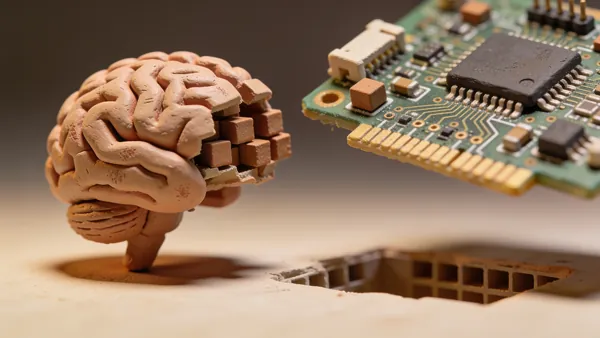
DeepMind's Kohli promised a phase transition in science. The post contains no measurement
DeepMind VP Pushmeet Kohli claims a 'phase transition' in scientific discovery, glimpse in weeks. The lab's record is strong; the post has no paper or number.
 Vlad Makarovreviewed and published

Pushmeet Kohli, a vice president at Google DeepMind, posted two sentences on LinkedIn on 8 November. Across the lab's projects, he wrote, his colleagues are "witnessing a genuine phase transition in the pace of scientific discovery", and "you will see a glimpse of this in our releases in the next few weeks". The text circulates mainly through relays such as this widely shared post on X, because the LinkedIn original resists scraping; outlets describe him as VP of Science, while his own profile lists VP at DeepMind and Chief Scientist at Google Cloud. What the post does not contain is a paper, a benchmark, a product name, or a date narrower than "a few weeks". As of 10 November, the DeepMind blog index carries no science announcement answering it.
The metaphor arrives without an order parameter
In physics a phase transition is a change of state at a critical point: ice to water, a magnet losing alignment as it warms. What makes the phrase quantitative is that each transition comes with an order parameter you can measure and a discontinuity you can point at. Borrow it for scientific discovery and you are making a claim about a derivative, not a mood: papers per researcher-year, validated targets per quarter, hours from hypothesis to assay, bending together at some identifiable moment. All of those quantities are counted by somebody. None of them appears in the post, and no threshold is named at which the bending would count as a transition rather than a good year.
What the post offers is the interior experience of a research organisation, which is real and not transferable. Any lab director who has had a good quarter could have written it.
The file that earns the sentence a hearing
It deserves one, because DeepMind's scientific record is not marketing. In November 2020 the CASP organisers, not the company, declared the fifty-year protein folding problem solved by AlphaFold; the verdict came from a blind assessment, and the output became an open database covering nearly every catalogued protein. AlphaFold 3 followed in May 2024, extending predictions from proteins to DNA, RNA and ligands, with Isomorphic Labs as a co-author and a commercial interest. AlphaProof and AlphaGeometry 2 reached silver-medal standard at the International Mathematical Olympiad in July 2024, with the method published in Nature in November 2025. AlphaEvolve, announced in May 2025, produced faster matrix multiplication algorithms and now runs inside Google's own data centres and chip design, a claim you can trust a little more because the savings land on Google's electricity bill.
The cleanest precedent is Co-Scientist. When DeepMind published it in Nature in May 2026, the validation was in vitro: drug repurposing candidates and combination therapies for acute myeloid leukaemia, tested at the bench rather than rescored in a model. That is what the lab looks like when it clears the bar the post gestures at. It is also why the vagueness reads as chosen rather than careless.
Where a glimpse ends and a trailer begins
Do the arithmetic the post declines to do. "The next few weeks" from 8 November puts the releases in roughly the last week of the month, which is a date anyone can hold him to. What arrives then falls into two categories.
A glimpse is a result you can check: a number set against a baseline, ideally by someone who does not work at Google, or a wet-lab confirmation of something a model proposed. A trailer is a chart from an internal harness, a demo on the vendor's own tooling, a video of an agent doing in an hour what a chemist does in a day. DeepMind shipped a trailer on 3 November, five days before the post: agentic cheminformatics on Google Antigravity, which compresses a multi-day drug design loop into an hour by searching thousands of compounds and proposing macrocycles with synthetic routes. It is useful engineering. It is not a discovery, and it never says what the hour is measured against.
Teasing is cheaper than publishing
The tease is rational in this market. Google's rivals have spent the autumn shipping agents, and a vice president who stays quiet while they post demos is a vice president losing a narrative. A sentence like this one costs nothing, reaches investors, recruits and the press, and prices the story before the artifact exists. If the releases are good, the post reads as prophecy. If they are demos, it named nothing specific enough to be wrong about.
A reply from @Chahatusharma under the relay asked the obvious question: "did Kohli name any specific releases? the quote just says next few weeks. curious if this is more AlphaEvolve and AlphaFold style science models or something new." That is close to the total information content of the original.
The audience has learned the pattern too. The r/singularity thread that carried the quote, at roughly 416 points and 95 comments when I looked, wants "actual releases or breakthroughs and not just an announcement of an announcement. Or another Carbon situation". Carbon, released on 28 October, went to the top of the Artificial Analysis index the day it appeared and, by one review that week, stayed out of reach for most users. The thread's best guess is materials science, helped by a trademark application for ALPHAMATTER that Google filed on 17 April, per the Justia record, covering AI software for simulating chemical and materials processes. A trademark reserves a name. It says nothing about what the name will do.
Three checks, none of them metaphorical
A paper with a baseline the authors did not pick after seeing the result. Wet-lab validation rather than retrospective reanalysis of compounds already known to work. At least one number that could have come out worse than the incumbents, printed next to the number that came out better.
That is not an unreasonable bar for the lab that solved CASP14, and it is the bar Co-Scientist cleared in May. If the releases at the end of November clear it, "phase transition" will look like an understatement and this piece will be the wrong one. If they are demos, the phrase joins the vocabulary AI executives borrow from physics because it sounds like a measurement and commits to nothing.