Trump told 60 Minutes the DOJ threatened an AI chief with prison. Nothing about it can be checked
Trump told 60 Minutes the DOJ warned an AI chief to get ready for jail. There is still no name, no company, no charge and no confirmation from anyone at all.
 Vlad Makarovreviewed and published
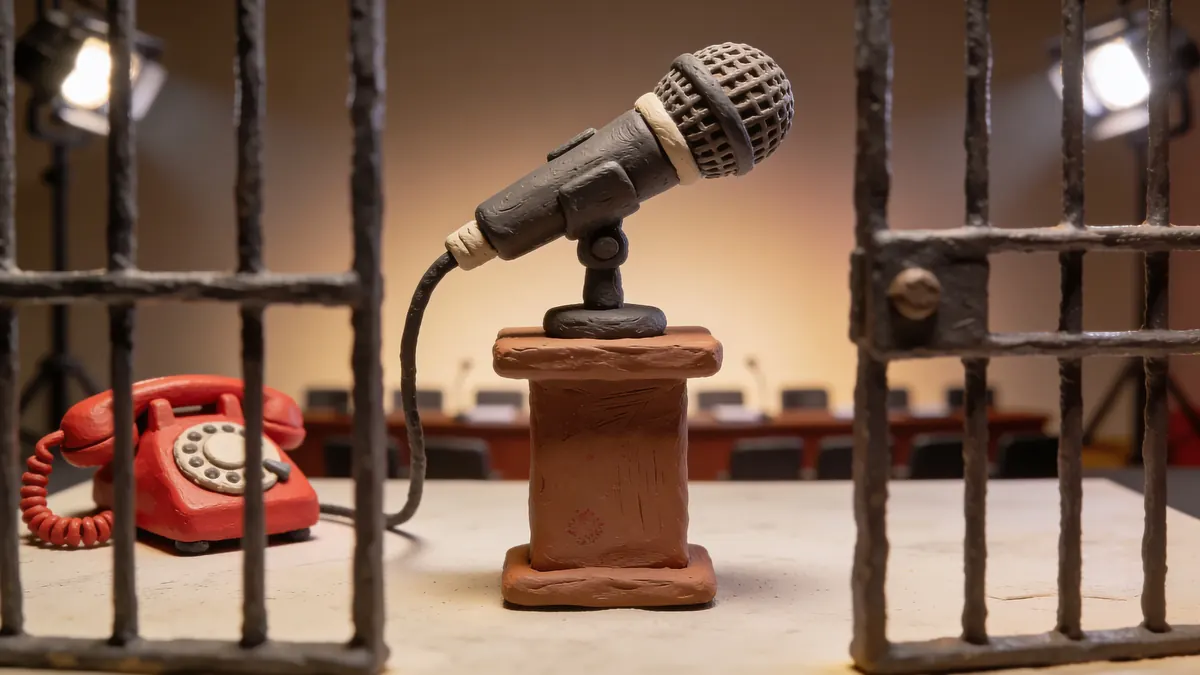
President Donald Trump used a question about AI risk on 60 Minutes this week to describe a prison threat that he says his own Justice Department made against the head of a frontier AI lab. The interview aired on Sunday night. Business Insider reported the exchange on Monday morning, and CBS has published the full transcript of the interview, whose extended cut is on YouTube. The account has a name-shaped hole in the middle of it: no executive, no company, no date, no statute and no filing. It is nonetheless a President, on the record, describing criminal exposure as a compliance instrument aimed at an AI lab, and that is a precedent whether or not the episode happened as told.
What he said, and the question it answered
The question was about doom. Ross Douthat asked why the warnings of the people building the technology should carry weight. Trump's answer was that the risk is smaller than they say and can be handled, and then he named the handler: "I think the risk can be managed. And it's managed, you know who? By who? The DOJ."
The story followed as evidence for that claim:
We had a situation where somebody was reported to us to be doing something bad with AI. We called them very strongly and said, "Get ready to go to jail. Please give your wife a kiss good night."
Douthat asked who the person was. "I can't tell you." Which company? "I can't tell you." What Trump would say is that he told the executive to "go home right now, see your wife and children, give 'em a kiss good night," and that "tomorrow morning, you're goin' to jail." The color orange came up, in a sentence the transcript breaks across Douthat's interruptions and Business Insider renders more cleanly as "Do you like orange?" Asked directly whether it was the leader of a major AI company, Trump said: "One of the big ones. Yeah." He added that the conduct was probably not malicious, "but it coulda been malicious," and that the person "totally changed everything. Totally. 'Yes, sir. Yes, sir.'"
Two published versions of the same ninety seconds already differ in punctuation and in how many sentences the threat occupies. That is worth noticing before anyone builds a theory on a comma.
There is no second side to check it against
There is no name to search for, no company to query, no date to bound the episode, and no statute named. Trump did not say what federal crime the conduct might have amounted to, and he did not say whether a case was ever opened. There is no indictment, no docket entry, no arrest, no company disclosure to shareholders and no statement from any lab confirming that its chief executive was called. Business Insider asked both the White House and the Department of Justice for comment; neither had responded when the story published.
What exists is a story with a happy ending: the threat was delivered, the behavior stopped, the risk was managed. That shape is the reason the claim is hard to attack. A success story needs no charging document, and the absence of one is what a success story looks like.
The one documented case ran through Commerce, not a courtroom
The administration has moved against a frontier lab before, and that record is written down. In June, after a trusted partner reported a jailbreak in the guardrails of Anthropic's Fable 5, the Commerce Department issued an export control directive. Anthropic disabled access to Fable 5 and Mythos 5 to comply, suspending use by any foreign national, including its own foreign employees. On 26 June Commerce Secretary Howard Lutnick permitted a limited release of Mythos 5 to government-approved organizations. On 30 June the controls were lifted entirely, roughly eighteen days after the directive.
Read that sequence as a template. When this administration actually constrained an AI lab in 2026, the instrument was an export licence administered by a cabinet department, documented in a directive, described by the company in a public statement, and reversed by a letter. It also asked OpenAI in the same period to limit the release of GPT 5.6 to approved partners, per CNN. None of that involved a prosecutor, none of it concerned an executive's personal conduct, and nobody has connected it to the story Trump told on Sunday. The jail account describes a different mechanism entirely, and it has produced nothing comparable: no directive, no company statement, no reversal, no date.
A promise with no jail attached, beside a threat with no document attached
The other instrument came in September, at a White House gathering with Sundar Pichai, Dario Amodei, Mark Zuckerberg, Greg Brockman, Elon Musk and Jensen Huang. They signed a voluntary safety accord covering internal controls, outside evaluations and board oversight. Trump called it "morally binding."
Both halves of that arrangement are worth stating plainly. The accord binds by adjective: voluntary, with no penalty clause and no public enforcement mechanism that anyone has described. The jail threat binds by anecdote: no text, no parties, no jurisdiction. If the second one happened, it is the only account of enforcement aimed at a lab's conduct rather than at who may use its models, and it operated before any rule was written, outside any docket, and entirely on the strength of a phone call that the person receiving it has never confirmed.
The guessing is the tell
Futurism's write-up walked through the only discriminator the story offered, which was that the executive has a wife and children. That would seem to exclude Apple's Tim Cook, who has no children, and OpenAI's Sam Altman, who has a husband and one son; Elon Musk is divorced; Anthropic's Amodei, per the Wall Street Journal, may or may not have children. Zuckerberg and Nvidia's Jensen Huang fit it. A thread on r/singularity, at roughly 500 points and about 180 comments when this was written, split accordingly. "It has to be Dario, everyone else has bent the knee," one poster wrote. "Dario doesn't have kids right?" another replied. "Has to be Zuck." A third comment, upvoted past 400, rejected the exercise: "It doesn't have to be anyone. Trump lies."
Every one of those readings is an inference from a family photograph. The two most popular identifications contradict each other; the third is unfalsifiable in the opposite direction. None of them is evidence, and the fact that the argument has to proceed by counting a chief executive's children is the clearest statement available of how little the claim contains. It is a claim about a person who may not exist in the form described, and the guessing is what fills the space a document would have occupied.
What would settle it
A referral from the Justice Department to a US attorney. A charging document, or a docket entry. A named company confirming that its chief executive was contacted and warned. An on-the-record denial from the executive in question, or a correction from the White House. Any one of those turns ninety seconds of television into a fact with edges.
Until one arrives, the sentence stays where it is: a President's recollection, on camera, that his Justice Department threatened an AI executive with prison, with nothing behind it that anyone can hold. That is worth reporting, and it is worth repeating only with the sourcing gap attached. The story will circulate for years, and it can never be disproved, which is exactly why it should not be passed along as though it had been.