Inworld open-sourced a denoiser and scored it top on a benchmark nobody can audit
Inworld released Voice Isolator, a 48 kHz speech denoiser under Apache-2.0, and ranked it first on VIBE, its own benchmark that outsiders cannot audit.
 Vlad Makarovreviewed and published
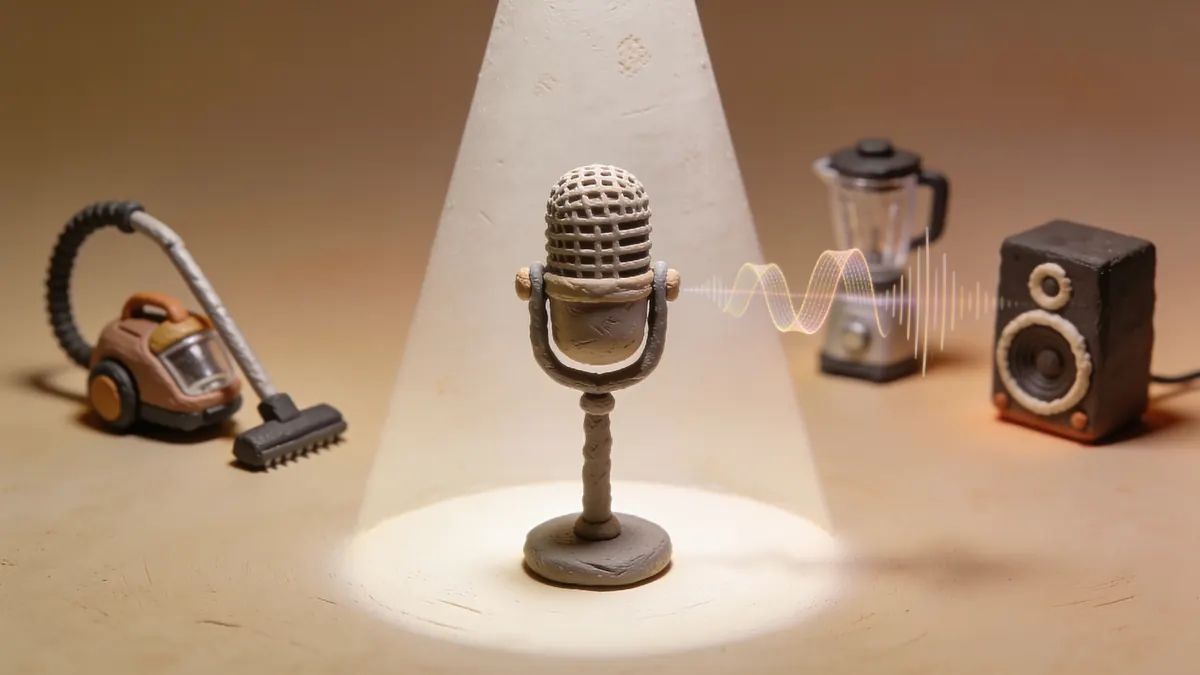
Inworld, the AI character and voice company, released its first open-source model this week: Voice Isolator, a speech denoiser under Apache-2.0 for both code and weights. Not weights-only, not a research licence. The permissive terms are the interesting part, because the benchmark behind the headline number is not public.
Two checkpoints, one architecture
The blog post ships two checkpoints on one architecture. voice-isolator-v1 is offline, 64.0M parameters, every frame seeing its whole eight-second chunk. voice-isolator-v1-realtime is 58.2M parameters and causal, holding 20 ms of look-ahead — enough for a live voice agent.
- Output: 48 kHz mono, float32 WAV, original levels preserved
- Separation: isolated voice plus removed background sums back to the input, so the background can be recovered by subtraction
- Architecture: band-split dual-path network over an STFT (n_fft 2048, hop 480), 46 bands, seven blocks — four with time attention, three with Mamba across time and across bands
- Runtime: CUDA, Apple silicon Metal on PyTorch 2.6+, and CPU; pip package inworld-voice-isolation, CLI voice-isolate
A private benchmark, quoted carefully
The score comes from VIBE, Inworld's Voice Isolation Benchmark and Evals, on a scale from 0 (unprocessed input) to 1 (clean reference). On the full-band denoising board: Inworld offline 0.768, realtime 0.718, ClearerVoice MossFormer2_SE_48K 0.695, resemble-enhance 0.646, FastEnhancer-L 48k 0.589, DeepFilterNet3 0.510.
Real numbers against real competitors, and also unaudited, produced by a company with a product to sell: VIBE is described as "a private benchmark for now." The written claim is narrower than the table: "best among the open-source denoisers we were able to test." Which denoisers, tuned how, is not disclosed.
What it will not do
The model card is blunt. The checkpoints "are not a speaker selector or a restoration model"; restoration arrives in version 2; it only denoises, deliberately, so it does not bias downstream speech-to-text; smaller GPUs are untested. Adoption is thin by Inworld's own account — downloads are not tracked, no inference provider serves it, though 3 finetunes and 2 quantizations exist.
The r/LocalLLaMA thread from 18 November topped out on laugh tracks: "Finally might be able to remove the excessive audience laughing in my favorite TV shows from the 80s and 90s...." wrote u/Iostminds. Lower down, u/bradjones6942069 said the model plus an Nvidia restorer made his late father's only recording audible — the restoration Inworld says it does not attempt.
The stated goal is to keep the person, not merely subtract noise. Breaths, laughs and "hmm"s are retained because those cues tell a live agent when to yield. A sane brief for a voice-company component released under a licence that costs Inworld nothing, arriving in the same month as Mistral's own voice stack. Whether the mask is actually better than the rest is a question the vendor cannot settle by itself.