Nine documented borrowings, and the half of the traffic nobody records
Sebastian Raschka's chart traces nine architectural borrowings between US and Chinese open-weight models, and explains why the reverse traffic goes unrecorded.
 Vlad Makarovreviewed and published
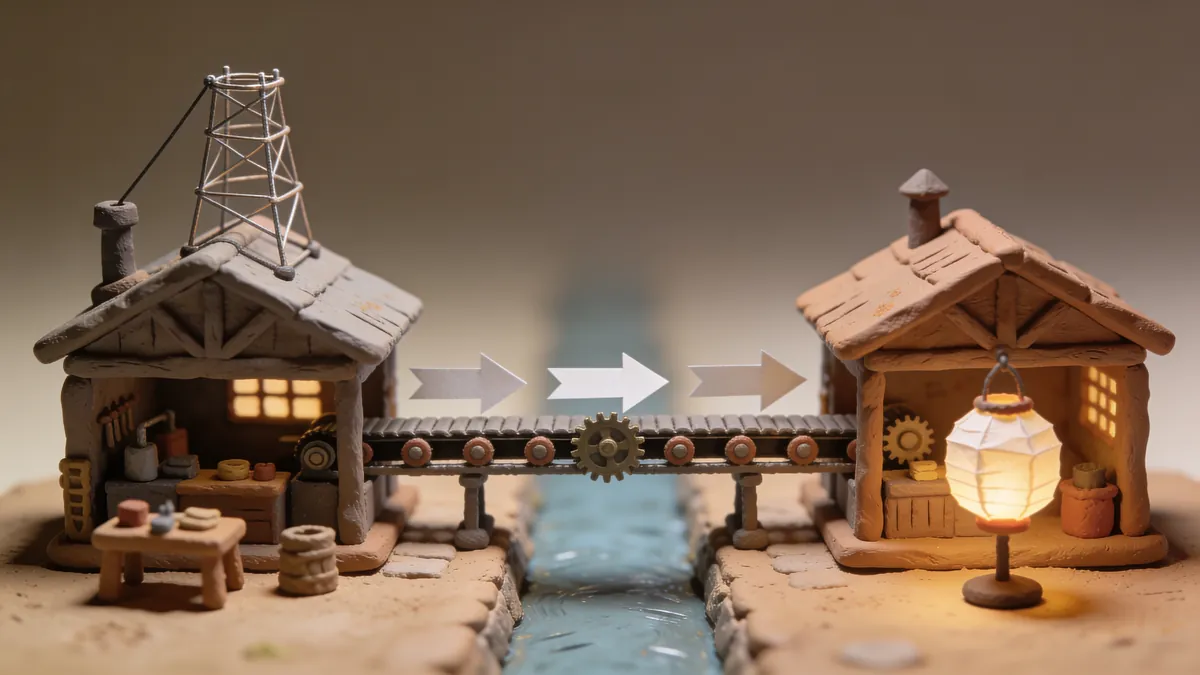
On 21 November, Sebastian Raschka published a short note built around one image, titled "The US-China Open-Weight Feedback Loop". It lays models from 2021 to 2026 on two sides of the Pacific and draws arrows between them: rotary embeddings from a Chinese paper into Meta's LLaMA, grouped-query attention from Google into DeepSeek, DeepSeek's attention design into Kimi K2 and AMD's newest mixture-of-experts. By 23 November it had reached r/LocalLLaMA, where the thread drew roughly a thousand points and seventy-five comments.
The claim, and the caveat attached to it
The post is a note, not an essay: a figure, a supporting table, and three sentences of framing. Raschka's framing is the part that traveled. He writes that he seriously thinks US open-weight models would not be this good without Chinese open-weight models and vice versa, and that proprietary models would not be this good and cheap without open-weight models either, before closing with the line that competition is a good thing.
The table carries the evidence, and Raschka flags its limits himself. "Note that the figure is not a comprehensive list, but just a selection." Nine rows, each pointing at a paper. That caveat does more work than it looks like it does, and we will come back to it.
What actually moved between these models
It helps to see the mechanisms, because "borrowing" here describes a published design decision rather than a copied file. Take the three that recur across the table.
Rotary position embeddings, RoPE, are how LLaMA tells the model where a token sits. Older designs added a position vector to each embedding or learned a table outright. RoPE instead rotates the query and key vectors by an angle proportional to position, inside every attention layer. Relative distances survive the rotation, so attention recovers order from geometry. The method comes from RoFormer, and Meta adopted it wholesale.
Grouped-query attention addresses the cost of the key-value cache. Full multi-head attention stores a separate key and value for every query head; multi-query attention stores one set for all of them, which saves memory and dents quality. GQA, from Ainslie and colleagues at Google, sits between those poles: query heads are divided into groups, and each group shares a key and value pair. DeepSeek LLM 67B used it in 2023, and it is now close to default.
Multi-head latent attention is DeepSeek's answer to the same problem, pushed further. Rather than caching full keys and values, it caches a compressed latent vector and reconstructs keys and values from it during inference. As Raschka puts it, keys and values share a compressed representation in the cache. That buys a much smaller cache at a quality cost Kimi K2 evidently accepted.
The nine pairs, as he documents them
| Year | Model | Mechanism and where it came from |
|---|---|---|
| 2023 | LLaMA | RoFormer's rotary position embeddings |
| 2023 | DeepSeek LLM 67B | grouped-query attention, Ainslie et al. |
| 2024 | OLMoE | DeepSeekMoE's fine-grained expert design |
| 2024 | DeepSeek-V3 | Meta's multi-token prediction objective |
| 2025 | Kimi K2 | DeepSeek-V2's multi-head latent attention |
| 2025 | Qwen3-Next | Gated DeltaNet's gated delta rule |
| 2026 | Trinity Large | Qwen's gated attention, a learned sigmoid gate |
| 2026 | Instella-MoE | DeepSeek-style MLA plus output gating |
| 2026 | Marin Mochi | Jianlin Su's quantile balancing for routers |
Read the third column and a pattern appears that the headline framing underplays. The arrows do not run in one direction. Meta's multi-token prediction objective, where a small extra module is trained to predict one token beyond the usual next-token target, went into DeepSeek-V3 in 2024. DeepSeek's MLA then went into Kimi K2 and into AMD's Instella-MoE, which pairs it with the attention output gating that Arcee's Trinity Large took from Qwen's work. Allen AI's OLMoE took DeepSeekMoE's fine-grained experts. American and Chinese labs appear on both the giving and the taking side of the same table, which is the actual finding, and it is more interesting than a scoreboard.
Why one direction is legible and the other is not
Every arrow in that chart can be checked. A borrowed mechanism arrives with a paper, a citation in a technical report, and an open checkpoint whose configuration file names the attention variant. Anyone with the weights can open them and see what is inside. That is why the open-to-open traffic looks dense: it is the only traffic with a paper trail by construction.
Closed labs leave no equivalent record. Their system cards describe capabilities and evaluations, not lineage, and a proprietary model cannot be inspected to see whether it uses RoPE, GQA or a latent cache. So the chart cannot show closed models borrowing from open ones, and does not claim they do. The thread made the sharper version of the point anyway, and it is worth quoting because nobody in a position to answer it has: "We won't know how many ideas close models borrow from the open ones. They won't acknowledge them except accusing open models of distillation." One of the earliest replies was shorter and cheerier, that open source makes everyone better, which is a sentiment rather than a measurement.
Raschka also revises in public. When a commenter objected that mixture-of-experts came from Mistral rather than DeepSeek, he agreed the timing was close and added that Mistral later took the complete DeepSeek architecture for its own models, along with a note that an updated figure should include European labs. That exchange is the most useful thing in the thread: the map is a live document maintained by one person reading papers, not a census.
Selection is evidence of a pattern, not of a magnitude
Nine curated pairs can establish that cross-border borrowing happens and that it runs both ways. They cannot establish how much of either lab ecosystem's progress came from the borrowing. That requires a counterfactual nobody has run, and Raschka's third sentence, about proprietary models being this good and cheap only because open weights exist, is his judgment about the industry rather than a result in the post. It may well be right. It is not something the figure measures.
There is also the selection problem, stated plainly by its author. A figure assembled by one reader out of memorable cases will over-represent the mechanisms that got named loudly and under-represent the ones absorbed quietly. Commenters supplied candidates the chart misses, including DeepSeek work that spread to other builders without appearing in a Western model. Add the geography and the same bias applies, which is why Raschka's own reply about European labs cuts against reading the chart as a complete account of anything.
What would settle the stronger claim
Two kinds of evidence would move this from a good illustration to a measurement.
The first is an ablation. Take a model that uses a borrowed mechanism, swap in the design it displaced, retrain under matched data and compute, and report the loss and throughput difference. That isolates the contribution of the mechanism itself rather than of the model around it. Labs publish this kind of comparison for their own components and almost never to settle credit between labs, which is why the argument stays unresolved.
The second is a citation graph built mechanically rather than curated by hand, covering papers, technical reports, model cards and published configuration files. It would not prove that a mechanism caused a capability gain, but it would count the traffic instead of sampling it, and make omissions visible as gaps in a graph rather than as gaps in a reader's memory.
Until then the defensible claim is the narrow one, and the chart supports it well: open weights and open papers let anyone audit who built on whom, and the audit shows traffic in both directions. The bolder claim about how much that traffic is worth remains an educated guess, offered by a careful reader on a figure that says of itself that it is a selection.