The weights say Blackwell. They do not say where the Blackwell was.
A forensic report finds NVIDIA Blackwell init fingerprints in six Chinese models. Its code reproduces five, and its own caveats undercut the loudest headlines.
 Vlad Makarovreviewed and published
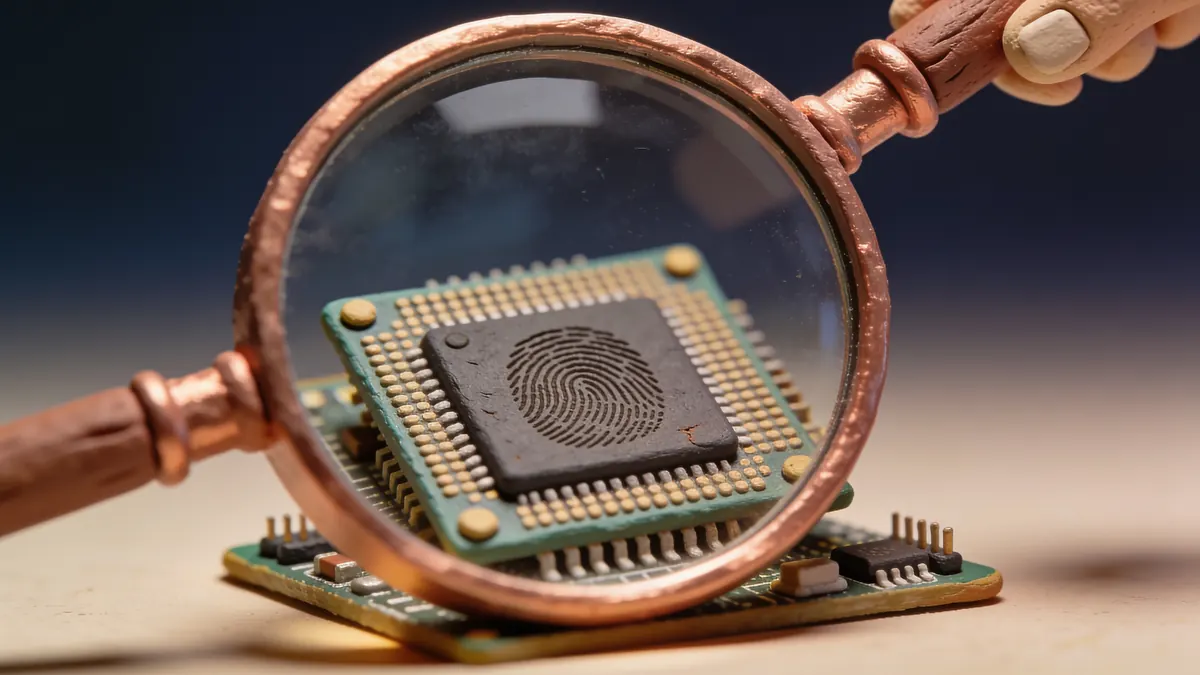
Six open-weight Chinese models carry the statistical residue of NVIDIA Blackwell accelerators, according to a forensic report published on 12 November by Unemployment Labs. Coverage travelled faster than the caveats. The report's own first principle is narrow: the fingerprint "supports, without proving, the inference that Blackwell also performed the training."
What the weights demonstrate is that a random number generator with a particular SM count wrote the untrained parameters of these networks. What they do not demonstrate is a datacenter address, a purchase order, or a violation.
What a checkpoint remembers about the machine that made it
The evidence comes "entirely from the models' own published weights, rather than from leaks or insider accounts." It leans on a detail of PyTorch's CUDA random generator, visible in DistributionTemplates.h: a normal-initialization launch runs 2,048 threads per streaming multiprocessor, each walking its own Philox stream, so element i is written by thread i mod G, where G is 2,048 times the SM count. A seed produces identical numbers on every GPU; only the positions differ, and the positions are the hardware.
Most of that signal dies in training. But a token that never appears in the corpus never receives a gradient, so its embedding row keeps its initial value: a fossil inside a finished checkpoint. DePue brute-forced seeds across all 2^32 values and every SM count from 16 to 256 until a layout reproduced the surviving rows. Correlations came back at 0.999999 for DeepSeek-V4-Flash and 0.999996 for Kimi K3; a seed-plus-one control collapsed to nothing.
| Model | Lab | SMs | Hardware the layout matches |
|---|---|---|---|
| DeepSeek-V4-Flash | DeepSeek | 148 | B200 / B300 |
| MiniMax-M3 | MiniMax | 148 | B200 / B300 |
| DeepSeek-V4-Pro | DeepSeek | 152 | GB200 / GB300 |
| Kimi K3 | Moonshot | 152 | GB200 / GB300 |
| Kimi K3.1-Pro | Moonshot | 152 | GB200 / GB300 |
| Ling-3.1-flash | Ant Group | 152 | GB200 / GB300 |
Each row separates a Blackwell from a Hopper and claims nothing more.
The previous generation, and the labs' own disclosures
The same technique applied backwards lands on Hopper for older checkpoints from the same organisations: DeepSeek-V3 from December 2024, Kimi K2 from July 2025, Kimi K2.5 from January 2026, MiniMax-M2.7 from April 2026, Ling-3.0-flash from August 2026. Two of those labs disclosed H800 fleets, the export-legal H100 variant, and the forensics agree without sharpening the claim, because H100, H800 and H200 are all 132 SMs. That sits oddly against April reporting that V4 would run on Huawei silicon; inference and initialization are different steps.
Kimi K2.7-Code sits awkwardly between the cohorts: Hopper-era weights in bulk, with one small component matching the 148-SM Blackwell layout. The report does not resolve what that means, so the table above is not a clean generation boundary.
The labs that did not switch are the interesting half
Not every Chinese lab is in the Blackwell column. The newest models read from Alibaba's Qwen line, Zhipu's GLM line, Tencent, Xiaomi and StepFun all came back Hopper-trained. Meituan says LongCat-2.0 trained entirely on "AI ASIC superpods," and the report found no NVIDIA fingerprint in its weights.
That distribution is the strongest argument the report has, and not the one the headlines used. A method that returned Blackwell for everything would be worthless. One that returns Hopper for Qwen, GLM, Tencent, Xiaomi and StepFun, a null result for an ASIC-trained Meituan model, and 148- or 152-SM layouts for six checkpoints is doing something. The negatives are a control the author did not have to publish.
They also support a reading less dramatic than smuggling. Compute arrives unevenly: a lab with older inventory trains on it, a lab that lands a 2026 allocation initializes on it. The pattern resembles procurement timing, not a single illicit shipment, though procurement timing is exactly what export controls are meant to shape.
The AMD caveat is printed, not buried
Three qualifications sit in the report in plain text, worth quoting rather than paraphrasing. The fingerprint "supports, without proving" the training inference. Specifically configured AMD hardware "is the only alternative we have identified." And the findings "do not establish where the chips were located, how access was obtained, or whether export controls were violated."
The repository turns that caveat into arithmetic. Its README notes that "GB200 and GB300 are both 152 and so is an AMD MI300X in two-way partition mode. A stock MI300X is 304." The 152-SM match has a named non-NVIDIA explanation; DePue found no evidence of it in the weights he examined. GB200/GB300 is the simplest fit, not the only one.
The location gap is structural, not a hedge. Initialization is one step that can happen anywhere: a lab could generate starting weights on one machine, ship the checkpoint, and train elsewhere for months. The report's own summary is that this is "the GPU that created the starting weights. It doesn't say where the training happened after that."
The code is thin, real, and runs in seconds
The reproduction can be checked, and the result is mixed. The repository exists, is MIT-licensed, and was created on 13 November at 05:39 UTC with a single commit three seconds later: four Python scripts, a 9 KB model index, 7 MB of copied embedding rows. The checker re-runs the Philox generator on CPU and rebuilds the untouched rows at every SM count.
The catch is scope. The README promises the check "for five models," not six: DeepSeek-V3-Base as the Hopper control, DeepSeek-V4-Flash, Kimi K3, MiniMax-M3 and Ling-3.1-flash. The rows behind DeepSeek-V4-Pro, Kimi K3.1-Pro, MiniMax-M2.7, Ling-3.0-flash and the K2 family are not in the package, so those claims cannot be re-run from the repo. Ling-3.1-flash also reproduces at 0.983 rather than five nines, which the README blames on its truncated-normal initializer.
Stronger is the physical check: a second script runs stock PyTorch on real accelerators, with nothing in the repo generating the numbers. An H100 matched DeepSeek-V3 eight rows out of eight bit for bit, and none of V4-Flash's 469. A B300 matched 461 of 469 and zero of V3's eight. A GB200 matched Kimi K3 thirteen of thirteen. Three GPUs is not independent replication. It is also not a claim that lives only on a laptop.
Who is making the claim
Will DePue is a former OpenAI researcher who worked on Sora and post-training, and earlier founded DeepResearch. Unemployment Labs calls itself "a small, independent research group," a nonprofit of ex-frontier-lab researchers and engineers, and is currently raising money to fund six more months of work. There is no journal and no review.
That is worth stating, then setting aside: the alternative to a funded independent lab is not a neutral one, it is nobody checking. The report ships code, sample rows and a stated seed, which is more than most industry safety claims manage.
What the fingerprint can settle, and what it cannot
This is real evidence of a hardware generation inside a checkpoint, and it converts a supply-chain rumour into an artifact anyone can inspect. It cannot support the sentence most readers took away: proving Blackwell silicon touched a Chinese model is not proving it sat in China, nor that a rule was broken. The regulatory machinery operates on where hardware is and who may buy it, neither of which the weights record.
A further twist cuts against the technique's future. Nothing forces a lab to preserve the fossil: re-saving embeddings through any other initializer, or training long enough to touch every row, erases the trace. DePue found what he found on checkpoints that happened to retain it. If he is right, the rational response from a lab that wants to avoid the next report is not to change hardware but to change a line of code.
Until someone independent reproduces 461 of 469 on their own B300 and publishes the rows, treat this as a strong technical result with a policy tail it cannot carry. The Kimi K3.1 Pro weights are the next test: 1.56 TB of them are public, and the 152-SM finding for that model is one the repo does not yet let you check.