The Journal says Nvidia financed its own demand. The number that matters is $125 billion, not $250 billion
A Journal report says Jensen Huang financed AI startups to absorb prepaid TSMC supply. The real number is a $125 billion guarantee cap, not a GPU price.
 Vlad Makarovreviewed and published

The version of this story travelling through hardware forums is that Nvidia invented the GPU shortage. What the reporting actually describes is narrower and, in some ways, less flattering: Nvidia committed to buying more silicon than it could sell, and then lent its balance sheet to companies that would buy the excess. Two outlets relayed the Wall Street Journal report on 13 November, and the arithmetic inside it is the part worth reading slowly.
What the Journal is reported to have found
Both Wccftech and TechPowerUp trace the report to an August 2026 meeting between Jensen Huang and Nvidia's senior finance team, including chief financial officer Colette Kress, who is now interim chief executive after Huang's resignation this week.
According to those accounts, Kress argued for reining in Nvidia's circular financing commitments to smaller cloud providers and to large AI firms including OpenAI and Anthropic. Huang, the report says, responded by belittling her, calling her quote "a deer in the headlights" end quote.
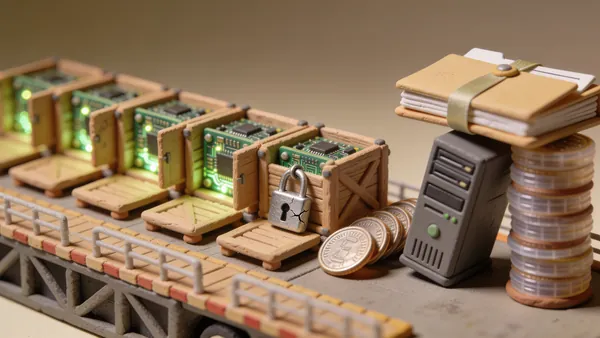
The supply side of the story is the load-bearing part. Nvidia had prepaid for TSMC wafers and memory at volumes that, in Huang's reported private assessment, were coming at the company "like an avalanche" once hyperscalers began shifting work onto their own custom accelerators. The company reportedly went back to TSMC to wind down upcoming orders.
Two different numbers, one of them is a ceiling
The figures most worth your attention are the ones that moved. Wccftech, reading the Journal, says initial discussions floated underwriting roughly 8 gigawatts of OpenAI compute valued at up to $250 billion, and that Kress succeeded in scaling Nvidia's signed guarantee cap down to roughly 4.25 gigawatts, or up to $125 billion. TechPowerUp describes the same negotiation as a $250 billion OpenAI deal that Kress pushed to scale back, without the gigawatt figures.
Every qualifier in those sentences is doing work. A guarantee cap is not a payment, "up to" is not a transfer, and a deal under discussion is not a balance-sheet item. The half that got cut, $125 billion of contingent exposure, is also the half that no filing has yet itemised. If the guarantee book exists, nobody outside Nvidia has seen it.
What is left after the deflation is still significant: a chip company financing buyers of its own product to clear supply it had already committed to, at a scale where demand had to be arranged rather than found.
Filings treat the two instruments differently. A commitment to buy wafers and memory is a known quantity and appears as an obligation. A guarantee that a customer's compute obligations will be covered is contingent, and appears only where it is judged material. That asymmetry is why the cleanest evidence for this story would not be a headline number at all. It would be a line item, and its absence so far is not proof of absence.
The problem Kress is reported to have raised
TechPowerUp adds a detail that Wccftech's summary omits and that makes the internal objection sharper. Part of Kress's concern was that the small cloud providers Nvidia was investing in could not afford to buy Nvidia GPUs in the first place, which would make them a financial dead end rather than a customer pipeline.
That is a different criticism from the one circulating. The forums' version is that Nvidia suppressed consumer GPU supply to keep prices high. The reported criticism inside the company is that Nvidia was extending credit to buyers who could not repay it in silicon purchases, in order to clear inventory it had already paid for. One is a pricing strategy. The other is a working-capital problem dressed as demand.
Wccftech also cites an earlier estimate from analyst Ed Zitron that at least $200 billion of Nvidia AI accelerators are sitting idle in warehouses, bought by cloud operators that lacked either the grid capacity or the end-user demand to run them. That figure is an analyst's estimate and not a Journal finding, and it should be carried as one.
Why it lands as a verdict rather than a report
The r/LocalLLaMA thread drew more than 130 comments, and the most-upvoted reading recast the company's open-weight advocacy as sales strategy: "He supported open models because it was selling shovels to miners."
That is a fair inference from a financing story and an unfair one from this particular report, which does not describe open-weight policy at all. The conflation is the interesting part. A week in which the chief executive resigns, employees petition for his return, and a newspaper publishes an August argument about guarantee caps has produced a single narrative in which every prior position is retroactively transactional.
The timing is also doing quiet work. The confrontation described is from August and the reporting arrived after Huang had already left, which makes it read as the explanation for his departure rather than as one internal dispute among several. Nothing published so far establishes that link.
What this does not say about your GPU
For anyone who buys a graphics card, the tempting conclusion is that the shortage was theatre. The reporting does not go that far. It describes excess supply at the top of the stack, prepaid wafers and memory that hyperscalers had stopped absorbing, alongside a constraint that Huang's own reported comments acknowledge: memory and packaging capacity does not expand on demand. A shortage of finished accelerators and a glut of prepaid components can be true at the same time, and this story is about the second.
What the report does describe is a company choosing to manufacture buyers rather than cut prices. Whether it could have cut prices instead is not a question the Journal is reported to have answered, and it is the question that would decide how much of the past year's pricing was engineered.
What would settle it
Three documents would move this from reported to established. Nvidia's next quarterly filing, which would show guarantee and purchase commitments if they are material. The full text of the Journal report, which is behind a paywall and which both relays compress differently on the gigawatt arithmetic. And any disclosure from OpenAI or the affected cloud providers about who carries the obligation if the compute is never used.
Until then the defensible sentence is the narrow one: Nvidia is reported to have financed buyers of its own product while sitting on prepaid supply it could not otherwise place, and its finance chief is reported to have tried to cap the exposure at roughly half the size originally discussed. Whether that made consumer GPUs expensive is a claim the reporting supports as motive and does not support as mechanism.